See first
Mentalism and Correspondence as instruments to read the invisible balance sheet beneath the visible one, and to face ninety days of transactions as an autobiography rather than an accusation.
 Alexandros Theon
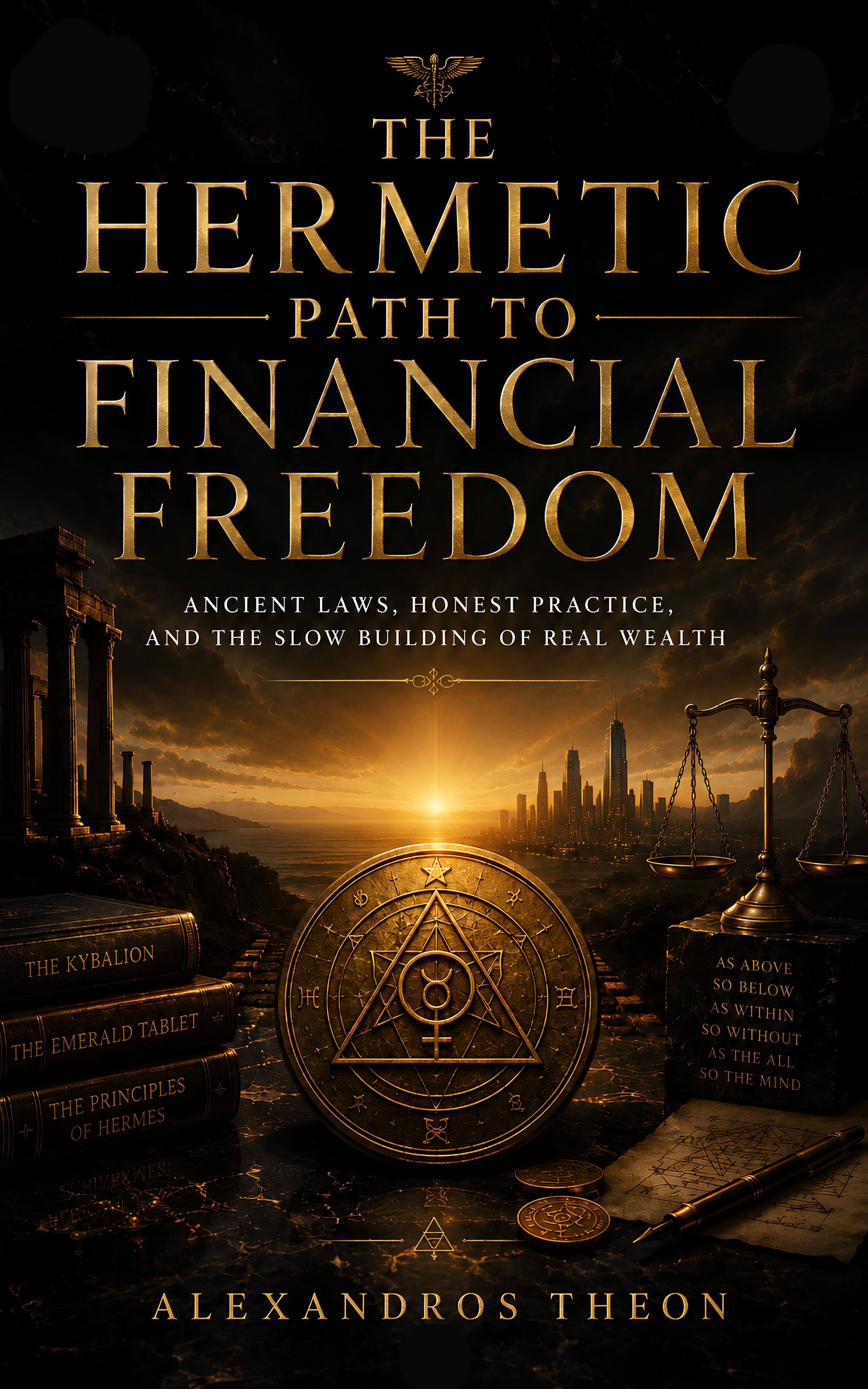
Alexandros Theon · Honest prosperity
Ancient Laws, Honest Practice, and the Slow Building of Real Wealth
Seven old instruments of perception turned on the most honest mirror you own: your money. Not to bend reality, but to see it. Not to attract wealth, but to stop repelling the slow, patient version of it that ordinary discipline builds.
The problem
A Tuesday in March, a little after eleven at night. Rafael sits at the kitchen table and realizes he has not looked, properly, line by line, at his money in almost two years. He has checked balances the way you check a wound you are afraid of: quickly, sideways, hoping. The number, when he finally adds it up, is four times his monthly income. And the thought that arrives is not how do I fix this, but something quieter: how did I not see this happening?
Sofia would not recognize that panic, which is exactly why she is in this book. Salaried for nineteen years, never overdrawn, no real debt, and a steady, low sense of falling behind: earning more than her parents and possessing less ease than they seemed to have. Her trouble is the slow one, the leak that never announces itself, because nothing in her life ever breaks.
"The laws were never about money. They were about the soul's relationship to a particular and revealing test, and money is only the test most of us cannot avoid taking."
From the conclusionWhat this book teaches
A bank statement does not narrate. It records. Every line is a decision you actually made, an unedited autobiography of what you did, not what you value. The seven Hermetic laws are presented as a training in attention, never as physics and never as economics. Where psychology supports them, the researchers are named and their findings stated honestly. Where there is analogy, it is declared as analogy. No asset is recommended, because principles age well and stock tips do not.
Mentalism and Correspondence as instruments to read the invisible balance sheet beneath the visible one, and to face ninety days of transactions as an autobiography rather than an accusation.
Vibration, Polarity and Rhythm applied to the contagion of spending, the swing between scarcity and abundance, and the discipline of not mistaking the swing for the trend at either end of the pendulum.
Cause and Effect and Generation applied to the forward chain of small repeated decisions and the long flat season in which real wealth gestates. The harvest the growing is for, named plainly.
Inside the book
Who this book is for
Who should not read it

About the author
Alexandros Theon is a literary pseudonym. The choice moves the center of gravity away from a personality and toward the library: a line of books created to study, organize and apply ancient principles with contemporary responsibility. The path is that of practical philosophy, with respect for every sincere form of seeking.
In the works of Alexandros Theon there are no promises of cure, guaranteed wealth or instant transformation. When they converse with science, they treat bridges as analogies, not as proof. The commitment is method, clarity and honest practice.
Continue the journey
The same seven laws as a general discipline of attention, with a twenty-one-day plan for everyday life.
The conceptual entry point: what the tradition is and what it is not, before you put it to work.
The same discipline of attention turned toward inner order and a confidence that endures.
Available on Amazon
Seven laws, eight practices, a ninety-day protocol and an honest note on the evidence. Read instantly on Kindle, your phone or your computer.
Buy on Amazon · $4.90Courtesy
Mentalism and the invisible balance sheet: the beliefs about money that operate before any decision does, and Rafael at the kitchen table beginning to ask a better question.
Prefer to keep it? Download the PDF.
Reader List
No spam, no empty promises. Only new books, courtesy chapters and notes from behind the library.