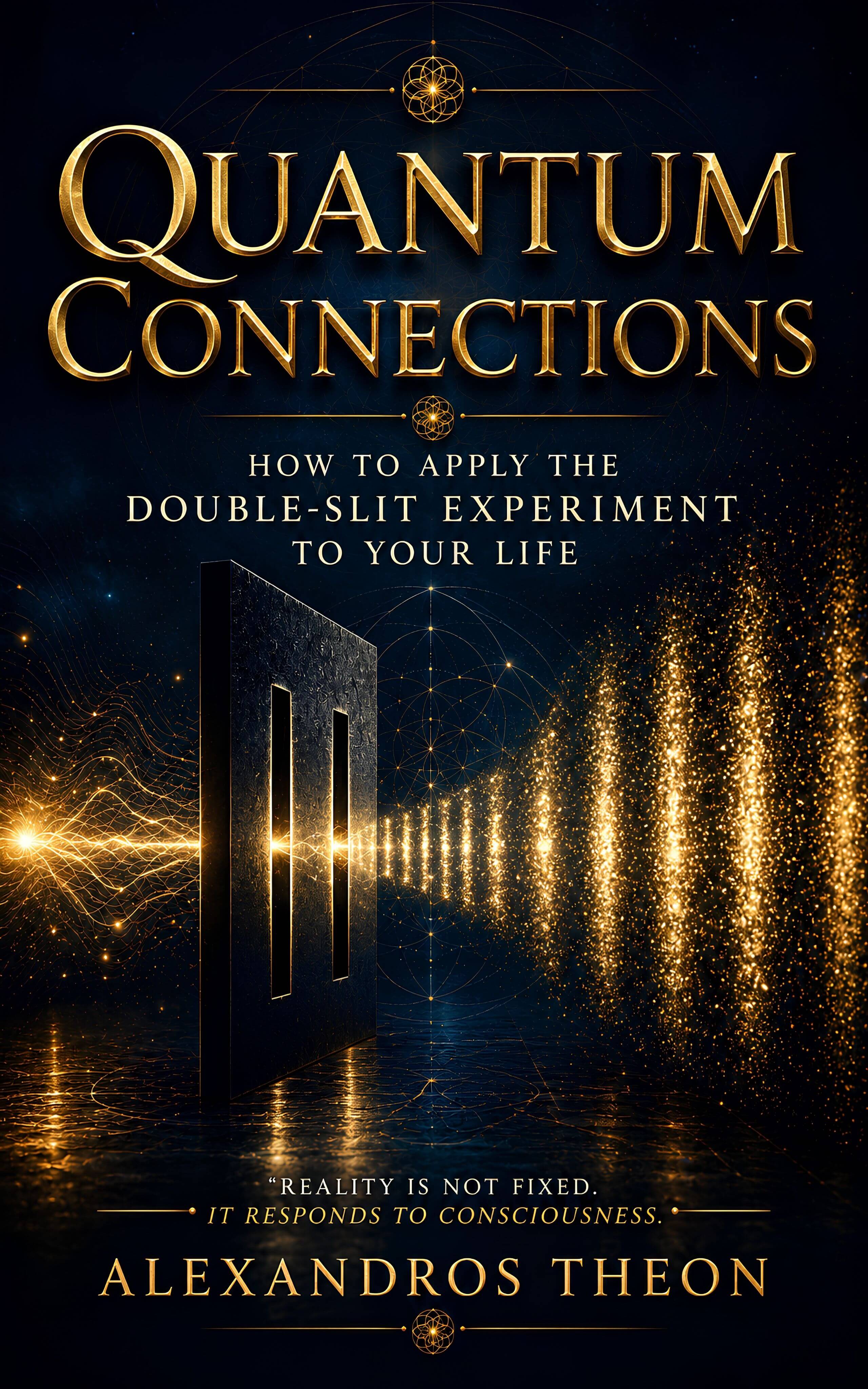
Quantum Connections

Alexandros Theon · Physics as a mirror

This book uses physics. It is not a physics book. And it will always be honest about which is which.

How to Apply the Double-Slit Experiment to Your Life

The strangest experiment in science, used openly and as a metaphor, as a mirror for how you perceive, decide and live. You will not find the claim that quantum mechanics proves your thoughts control matter. It does not, and an honest book says so. What you will find is more durable, and actionable on an ordinary Tuesday.

ENKindle$4.90ASIN B0FK2SVKSR

The problem

You spend your life adjusting the world and never once inspect the apparatus.

Elena is forty-one, a logistics manager, competent and tired. For six months she has circled one decision: stay in a stable role that has stopped growing, or accept a riskier offer. She has made spreadsheets. She has asked friends. Every analysis ends in the same fog. Her apparatus asks only one question of both futures: how could this go wrong? A mind tuned only to threat can detect only threat. The fog she complains of is not in the options. It is in the detector.

Most popular books would tell her to visualize the outcome and trust the universe. That mechanism is false, and where it fails it hands the believer a cruel arithmetic: every misfortune becomes evidence of insufficient optimism. There is a better road, and it begins by inspecting the instrument rather than staring at the screen.

  • You keep refusing a decision, confusing the discomfort of uncertainty with the danger of error.
  • Your analysis returns fear because fear is the only question your mind was built to ask.
  • You were sold a quantum-flavored promise that wishing rearranges reality, and life disproved it.
  • You suspect there is a real principle under the hype, if someone would separate the science from the slogan.
  • You adjust the world endlessly and never inspect the instrument doing the measuring.

"There is no such thing as observation without participation. To see is to disturb. To question is to alter the thing questioned."

From the first chapter

What this book teaches

The most precise metaphor science ever produced, used well.

The double-slit experiment is real science, replicated for two centuries. The observer in quantum mechanics is a detector, not a mind, and the experiment behaves identically whether a scientist watches or the data writes itself to a disk in an empty room. Nothing in the physics assigns a role to awareness. The book states this plainly, then makes a quieter wager: that the experiment gives precise form to truths the Hermetic tradition reached by another road, and that a metaphor both scientifically honest and practically fertile is rare enough to use with care.

The experiment, honestly

What actually happens at the two slits, what wave-particle duality and superposition prove, and, just as important, what they do not. A practice built on a misunderstanding collapses at the first hard test, so the honesty is the foundation, not a disclaimer.

The correspondences

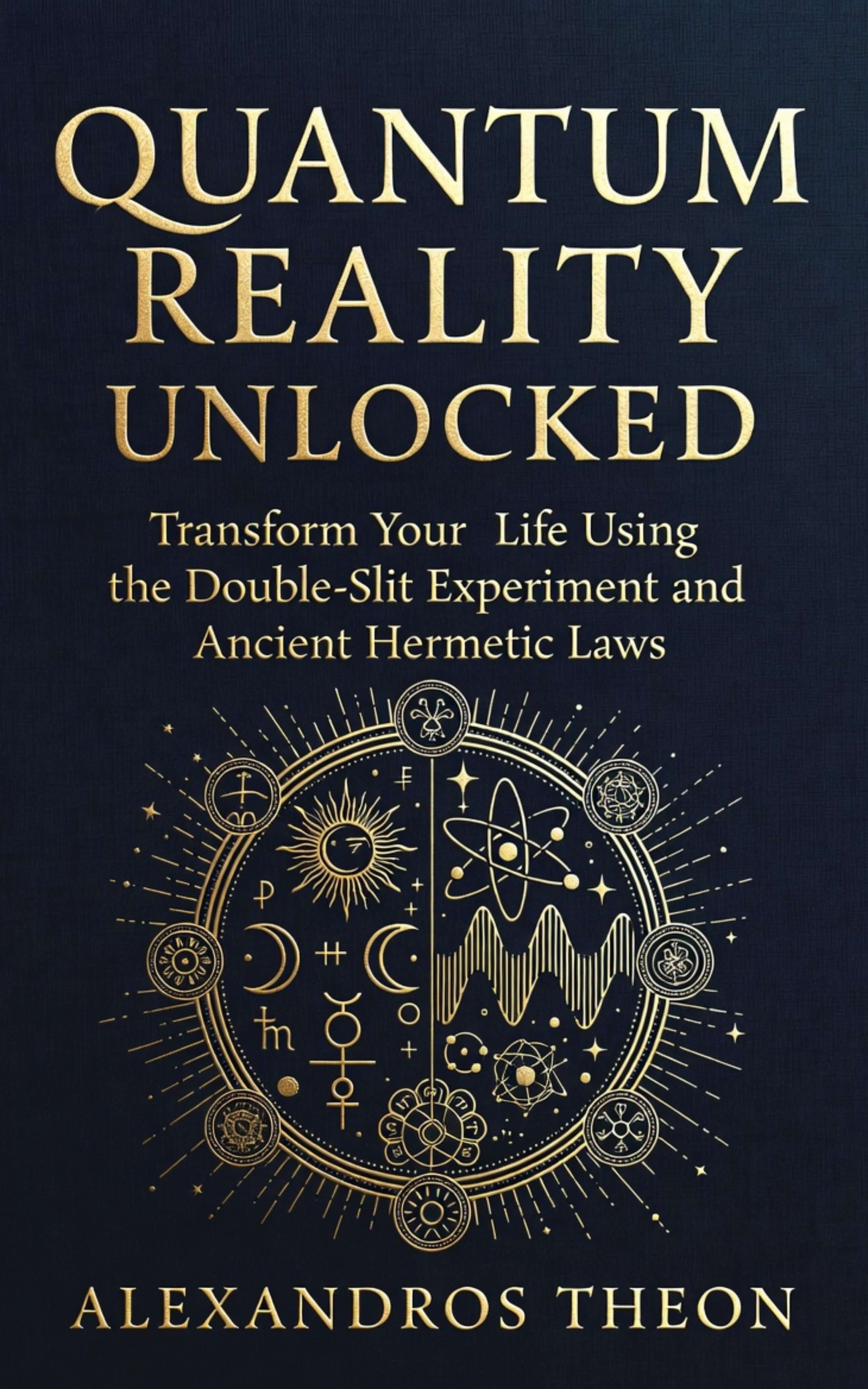
Each feature of the quantum world paired with one Hermetic law and one territory of life: duality with Polarity and how we face choices, uncertainty with Rhythm and the seasons of a career, state with Vibration, entanglement with Cause and Effect and the weight of our actions on others.

The practice

Correspondence turned into method: deliberate observation, decision under uncertainty, and a simple twenty-one-day protocol, so the book ends not in inspiration but in something you can do on a Tuesday. Read with a notebook; it improves when argued with.

Inside the book

What you will find in these pages.

  1. The honest mystery, told without embellishmentThomas Young in 1801, the 1989 Hitachi film of single electrons assembling into stripes, and Feynman's warning that the mystery should never be explained away. The strangeness stated clearly enough that you feel it, not merely read it.
  2. What the experiment proves, and what it cannotWave-particle duality, superposition, and measurement as a physical disturbance, set beside a frank account of why the observer is a detector and not your mind, and why the popular promises misread the science.
  3. Seven correspondences, declared as metaphorBefore the measurement, a field of weighted possibilities; the decision as the committed interaction that collapses them; the apparatus as the conditions of encounter. Each Hermetic law given precise form by one feature of the quantum world.
  4. Elena and other composites, openly declaredThe manager at the kitchen table who changed not her courage but her question, asking what each future would ask her to become. Drawn from many real lives so that every idea survives contact with an actual Tuesday.
  5. A method and a twenty-one-day protocolDeliberate observation, decision under uncertainty, and a daily practice, plus an honest glossary and a table of correspondences. The book ends in something you can actually do.

Who this book is for

This book was written for you if...

  • You are fascinated by the double-slit experiment and want it explained accurately before it is applied.
  • You want the science kept honest: metaphor declared as metaphor, the boundary never blurred to sell certainty.
  • You face real decisions under uncertainty and want a way to inspect the instrument you measure them with.
  • You bring skepticism, which here is not an obstacle but the correct instrument.
  • You will read with a notebook and run a twenty-one-day protocol rather than wait for a leap.

Who should not read it

And it may not be for you if...

  • You want confirmation that thoughts rearrange matter or that feeling a frequency attracts wealth and health. The book shows, plainly, that the physics says no such thing.
  • You want a technical physics textbook. This uses the experiment as a mirror for living, not as a course in quantum mechanics.
  • You are in a trough that will not lift. This speaks as philosophy, never as treatment; the right next step is a doctor or a trained professional.
Alexandros Theon

About the author

Alexandros Theon

Alexandros Theon is a literary pseudonym. The choice moves the center of gravity away from a personality and toward the library: a line of books created to study, organize and apply ancient principles with contemporary responsibility. The path is that of practical philosophy, with respect for every sincere form of seeking.

In the works of Alexandros Theon there are no promises of cure, guaranteed wealth or instant transformation. When they converse with science, they treat bridges as analogies, not as proof. The commitment is method, clarity and honest practice.

Available on Amazon

"Take the first reading tomorrow. Then take another. The screen does not care about the gaps. It cares about the total."

Ten chapters, seven honest correspondences, a method and a twenty-one-day protocol. Read instantly on Kindle, your phone or your computer.

Buy on Amazon · $4.90

Courtesy

Read Chapter 1 now, here on the site.

The most honest mystery in science: the 1989 film of single electrons, what the experiment proves and what it does not, the metaphor declared as metaphor, and Elena at the kitchen table changing her question instead of her courage.

Prefer to keep it? Download the PDF.

Reader List

Receive future releases.

No spam, no empty promises. Only new books, courtesy chapters and notes from behind the library.