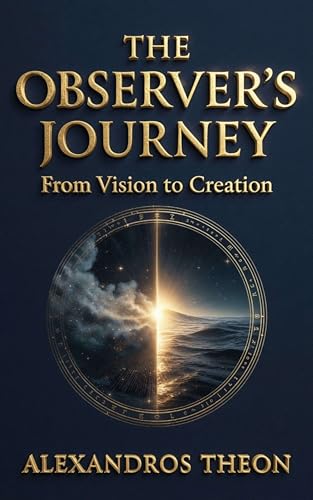
The Observer's Journey

Alexandros Theon · Attention and creation

This book will not tell you a single thing it cannot defend in daylight. Including, early on, its own title.

From Vision to Creation

You found this book on a shelf with a reputation: the shelf where thoughts are magnets and the universe takes orders. This is the audit. Under every false power it strips away, a real and humbler one is waiting, the only kind that holds weight. A serious adult would rather have a small true lever than a large painted one.

ENKindle$4.90ASIN B0FJZPZYYT

The problem

The books moved you, then quietly did not change very much.

Perhaps you have read those books, the ones where quantum physics is invoked the way incense once was, for atmosphere rather than accuracy. Perhaps some of them moved you, and then, over months, did not change very much, and you half-concluded the failure was yours, that you had wanted insufficiently or visualized impurely.

It was not your wanting. It was the method. Marina and Paulo leave the same forty-minute meeting certain of opposite outcomes, both intelligent, both attentive, both telling the truth. There was no neutral meeting to attend. Before you can create anything deliberately, you must reckon with the instrument through which you meet the world. The instrument is not a window. It is a workshop.

  • You visualized the prize, waited, and the visualizing quietly drained the pursuit instead of fueling it.
  • You repeated affirmations that backfired, especially on the days you needed them most.
  • You were told quantum physics proved your mind shapes matter, and some part of you never quite believed it.
  • You confused wanting with doing, and the gap between vision and creation stayed exactly as wide.
  • You suspect there is something real under all of it, if only someone would separate the lever from the paint.

"The mind does not transmit desires to the cosmos. But observation measurably changes the observer, and a watched habit begins to shift before any effort is applied."

From the note before we begin

What this book teaches

Under every false power it strips away, a real one is waiting.

That is the pattern, chapter after chapter. The observer effect of quantum mechanics says nothing about minds shaping matter, and the book shows exactly what it does say. The Law of Attraction is opened like an engine and inspected for the parts that actually move. Affirmations, vision boards and inspired action are each weighed, and where found wanting, you are told plainly. The seven Hermetic principles appear as instruments of attention and conduct, never as cosmic legislation. A tradition is respected by being tested, not by being inflated.

Attention, the one real lever

Attention does not bend the physical world; it selects which world you inhabit experientially, and that is where every choice is born. The chain is unglamorous and unbroken: attention, experience, interpretation, choice, action, outcome. No step is magic. No step is optional.

The honest replacements

Imagining the prize drains the pursuit; rehearsing the difficult moment, obstacle included, improves the performance. "I am confident" backfires for those who need it; identity built from small verified deeds compounds. The humble powers are the only ones that hold weight.

The bridge only action crosses

Between vision and creation stands a gap with one bridge, and it is the act itself. Inspired action audited, the ugly first act, the weekly loop that learns from real conditions, and the long middle where directions actually die or hold.

Inside the book

What you will find in these pages.

  1. A book brave enough to audit its own genreThe observer effect explained for what it actually is, the Law of Attraction opened like an engine, affirmations demolished and rebuilt, and inspired action weighed honestly. Where each is found wanting, you are told, even when the finding is unpopular.
  2. The seven laws as a grammar of realityPresented as instruments of attention and conduct refined by careful observers of inner life, with an honest bridge between ancient wisdom and modern science, and a caution wherever the metaphor is tempted to overreach.
  3. Daniel, an architect of forty-one, openly a compositeAssembled from many real lives so that every idea has to survive contact with an actual week, an actual fear, an actual Tuesday. His story runs to the last page, kept honest, which means no lakeside house at the end. Something better.
  4. Practices that stack into twelve minutes a dayFrom a five-minute observation discipline to a complete weekly architecture: the two accounts, five days of pure observation, the five-minute rehearsal, the ugly first act, the weekly loop. They build, each assuming the capacity the last one made.
  5. The whole practice gathered on a few pagesThe three gears, the instruments in order of construction, a first thirty days, and the boundaries gathered in one place, with the book reduced, finally, to a single defensible sentence.

Who this book is for

This book was written for you if...

  • You were drawn to manifestation books and left quietly unconvinced, suspecting a real mechanism under the hype.
  • You want claims you can defend in daylight, and you would rather have a small true lever than a large painted one.
  • You are ready to do the work in a notebook, since the book's real promise is collectible only on the second pass, with a pen.
  • You want attention, conclusions, habits and conduct treated as the governable territory, and treated seriously.
  • You respect a tradition enough to want it tested rather than inflated.

Who should not read it

And it may not be for you if...

  • You want thoughts to be magnets and the universe to take your orders. This book audits that promise and finds it wanting, on purpose.
  • You want quantum physics to prove that your mind shapes matter. Chapter 2 shows, plainly, that it says no such thing.
  • You are in a season where the evidence calls for professional help. This work walks beside therapy, medicine, and counsel; it never replaces them.
Alexandros Theon

About the author

Alexandros Theon

Alexandros Theon is a literary pseudonym. The choice moves the center of gravity away from a personality and toward the library: a line of books created to study, organize and apply ancient principles with contemporary responsibility. The path is that of practical philosophy, with respect for every sincere form of seeking.

In the works of Alexandros Theon there are no promises of cure, guaranteed wealth or instant transformation. When they converse with science, they treat bridges as analogies, not as proof. The commitment is method, clarity and honest practice.

Available on Amazon

"The person watching your life is the most consequential position in it, and it is usually unstaffed."

Twelve chapters, an honest audit of an entire genre, and a daily practice that assembles in twelve minutes. Read instantly on Kindle, your phone or your computer.

Buy on Amazon · $4.90

Courtesy

Read Chapter 1 now, here on the site.

The nature of reality: two people leave the same meeting having attended different ones, perception as construction rather than recording, and Renata's counting card, the whole mechanism in miniature. Plus the two-accounts practice.

Prefer to keep it? Download the PDF.

Reader List

Receive future releases.

No spam, no empty promises. Only new books, courtesy chapters and notes from behind the library.