North
What you already know to be true and have been avoiding. The peripheral truths, the economy of avoidance, and how admission is not the same as verdict.
 Alexandros Theon
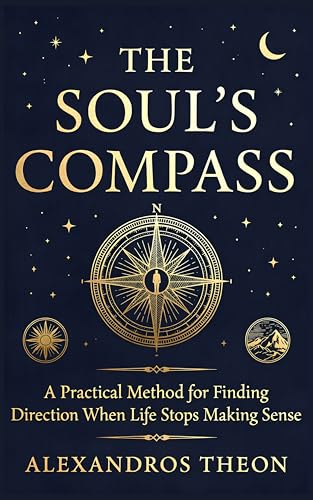
Alexandros Theon · Direction
A Practical Method for Finding Direction When Life Stops Making Sense
Not about success, which you may already have. Not about happiness, which no honest author can promise. Direction: the quiet sense that your days are pointed somewhere, and that the somewhere is yours. An instrument of four points, drawn from the Stoic and contemplative disciplines of self-examination, that turns a fog back into a landscape.
The problem
Daniel arrived early, as he always did. He sat in his car in the office garage, engine off, hands still on the wheel. Forty-one, director of operations, a house nearly paid off, a marriage without storms, two children he loved. By every measure he had been taught to use, he had arrived. He stayed in the car for eleven minutes that morning, held by a flatness he could not name and was ashamed to mention, because what right did a man with his life have to complain?
What Daniel was experiencing has no dramatic name, and that is its danger. It is not burnout, though it can lead there. It is not depression, though it can deepen into one and deserves professional care when it does. It is something quieter and far more common: the machinery works, and the soul has gone silent.
"The disorientation is not evidence that you failed. It is frequently evidence that you succeeded at a plan you outgrew, or a plan that was never entirely yours."
From the first chapterWhat this book teaches
If external maps fail here, and they do, what remains is the instrument the old traditions insisted upon: structured self-examination. Not the vague advice to look within, but fixed questions, regular practice, and written results, the way the Stoics reviewed each day in writing and the contemplative orders built the examen into every evening. The method organizes that discipline into the four points of a compass rose. The hermetic laws are not the framework here; the tools, this time, are the plainest the author knows.
What you already know to be true and have been avoiding. The peripheral truths, the economy of avoidance, and how admission is not the same as verdict.
What actually holds you when everything else shakes. Inherited ground versus chosen ground, and the shape of values you would keep through a double storm.
Where your energy genuinely wants to go. Energy as testimony, the two counterfeits that mimic it, and the dismissed pulls worth recovering.
What must be released for movement to become possible. The cargo you carry, why setting down is so hard, and the art of conscious endings.
Inside the book
Who this book is for
Who should not read it

About the author
Alexandros Theon is a literary pseudonym. The choice moves the center of gravity away from a personality and toward the library: a line of books created to study, organize and apply ancient principles with contemporary responsibility. The path is that of practical philosophy, with respect for every sincere form of seeking.
In the works of Alexandros Theon there are no promises of cure, guaranteed wealth or instant transformation. When they converse with science, they treat bridges as analogies, not as proof. The commitment is method, clarity and honest practice.
Continue the journey
A neighboring branch of the same old tree: structured self-examination through seven lenses and a daily practice.
Once you know your direction, the patient method for building the small habits that carry you there.
The wider tradition of self-examination and inner order, told honestly from the ground up.
Available on Amazon
Fifteen chapters, four points, a decision protocol and a first season mapped week by week. Read instantly on Kindle, your phone or your computer.
Buy on Amazon · $4.90Courtesy
The quiet disorientation: the symptoms no one reports, why capable people are the most vulnerable, the three boundaries that keep the diagnosis precise, and the eleven-minute practice that takes your first position.
Prefer to keep it? Download the PDF.
Reader List
No spam, no empty promises. Only new books, courtesy chapters and notes from behind the library.