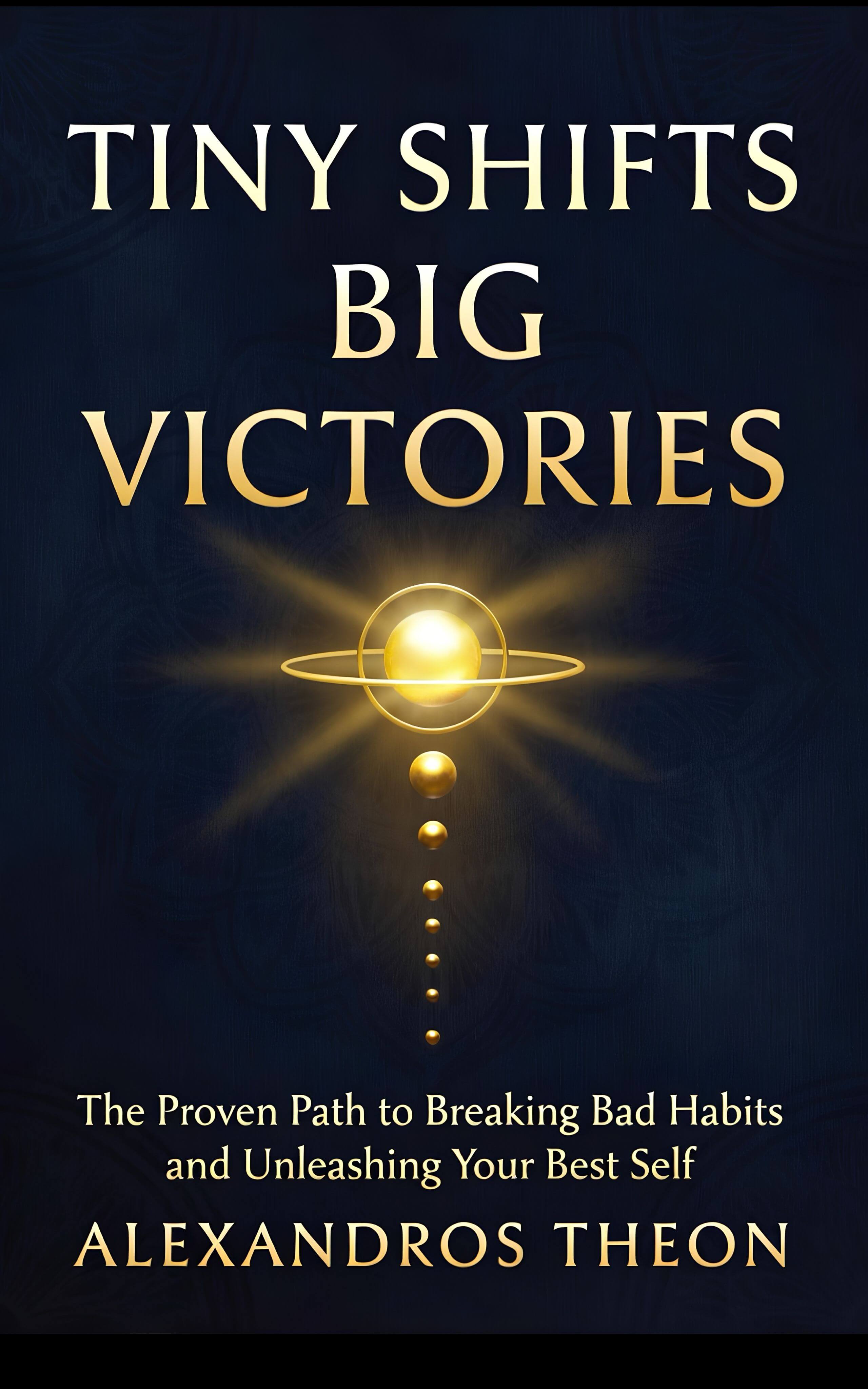
Tiny Shifts, Big Victories

Alexandros Theon · Habits and change

You do not lack discipline. You have been asking discipline to do a job that belongs to design.

The Proven Path to Breaking Bad Habits and Unleashing Your Best Self

Transformation almost never arrives as a leap. It arrives as a sequence of small, deliberate movements, repeated until they stop requiring effort and start constituting who you are. The leap makes a better story. The sequence makes a better life. This book is about that sequence.

ENKindle$4.90ASIN B0FJZ8XLPY

The problem

The fourth list titled "New Life," ambitious, sincere, and dead within eleven days.

On a Tuesday evening in late autumn, a man named Daniel sat at his kitchen table and wrote a list titled New Life. Wake at five. Run before work. No sugar. No phone after nine. Read forty books. It was the fourth such list he had written that year, and it died within eleven days. His failure was not a failure of character. It was a failure of method. He tried to replace an entire life in one gesture, and a life does not work that way.

Most of us resist the small-step idea for an understandable reason: small steps offend our sense of urgency. When life feels wrong, we want the correction to be as large as the discomfort. So we write lists titled New Life, burn out by the second week, and conclude, wrongly, that we lack discipline.

  • You have written the ambitious list, more than once, and watched it die by the second week.
  • You resolve to stop a habit on Monday and surrender, reliably, in the same seat at the same hour by Thursday.
  • You blame your willpower, when willpower is weakest in exactly the tired, stressed states your costliest habits fire.
  • You ask "why can't I stop?", a question that leads to shame, instead of "what keeps starting this?"
  • You suspect the real problem is not your character but the way your day is arranged.

"A shift small enough to repeat will outperform an ambition large enough to abandon, every time."

From the chapter on the method

What this book teaches

Lasting change is an engineering problem before it is a character problem.

You do not need to become someone stronger. You need to become someone better arranged. The book is precise about its promise, because the genre has a habit of promising too much. It will not make change effortless; nothing does. It offers a way of making change possible, then probable, then ordinary, with no guarantees and no suggestion that habit science replaces medical or psychological care when those are needed.

See the machinery

How habits are built and held in the brain, the cue, routine and reward loop, and why your resistance is not a moral defect but a mechanism you can work with. Much of what you call "just how I am" is procedure, and procedures can be rewritten.

Work the edges, not the will

The loop is most vulnerable at its edges, not at the behavior itself. Friction governs behavior: add a little and frequency falls, remove it and frequency rises. The disciplined are usually just people who arranged the right action to be the easy one.

Run the method

The Tiny Shifts Method, four movements you can carry in your head and run on any habit in any domain: See, Shift, Align, Anchor. Then a thirty-day protocol that turns the method into a daily practice sturdy enough for your hardest days.

Inside the book

What you will find in these pages.

  1. The anatomy of a habit, honestly explainedThe cue, routine and reward loop, the conservative brain that defends it, and a frank reckoning with willpower: not a myth, not a fuel tank, but a resource guaranteed to be absent at the decisive moment. The alternative is not strength. It is structure.
  2. Daniel, Marina and Alex, composites openly declaredThe man whose New Life lists keep dying, the nurse whose evenings dissolve into snacking she does not enjoy, the analyst who has spent four years silent in meetings. Drawn from real patterns, traceable to none. Recognition is what changes people, not abstraction.
  3. Seeing, interrupting, building, in that orderHow to spot the automatic sequences, default responses and defended territory you cannot normally see, how to interrupt a loop at the space between cue and routine, and how small wins build the self that makes the next win easier.
  4. The Tiny Shifts Method on one pageSee, Shift, Align, Anchor: choose the floor not the ceiling, match the real need beneath the habit, and anchor the new behavior to a cue that already fires, protected by the recovery rule of never missing twice.
  5. A seven-day start and a thirty-day protocolStructured enough to follow on your hardest days, light enough that it cannot collapse under its own weight, plus a one-page method summary and a simple habit tracker.

Who this book is for

This book was written for you if...

  • You have tried to change by force and willpower, and watched the ambitious version collapse every time.
  • You would rather engineer your environment than win a daily battle against yourself.
  • You prefer a small change that survives your worst day to a grand one that dies in a fortnight.
  • You want a portable method you can run on any habit, in any domain, for the rest of your life.
  • You value honesty: no guarantees, no rebuilt personality in thirty days, just the verifiable arithmetic of small repeated actions.

Who should not read it

And it may not be for you if...

  • You want a dramatic overnight transformation. The book offers compounding, not a leap, and says so plainly.
  • You are looking for guaranteed outcomes or a promise that thirty days will rebuild who you are. No honest book could make that promise.
  • You are facing addiction, compulsion, a difficult relationship with food or your body, or suffering larger than a habit. This accompanies professional support; it does not replace it.
Alexandros Theon

About the author

Alexandros Theon

Alexandros Theon is a literary pseudonym. The choice moves the center of gravity away from a personality and toward the library: a line of books created to study, organize and apply ancient principles with contemporary responsibility. The path is that of practical philosophy, with respect for every sincere form of seeking.

In the works of Alexandros Theon there are no promises of cure, guaranteed wealth or instant transformation. When they converse with science, they treat bridges as analogies, not as proof. The commitment is method, clarity and honest practice.

Available on Amazon

"Begin small. Begin anyway."

Six chapters, a four-step method, a seven-day start and a thirty-day protocol. Read instantly on Kindle, your phone or your computer.

Buy on Amazon · $4.90

Courtesy

Read Chapter 1 now, here on the site.

The anatomy of a habit: the hidden machinery of an ordinary day, the cue, routine and reward loop that runs you, an honest reckoning with willpower, and why structure beats strength every time.

Prefer to keep it? Download the PDF.

Reader List

Receive future releases.

No spam, no empty promises. Only new books, courtesy chapters and notes from behind the library.