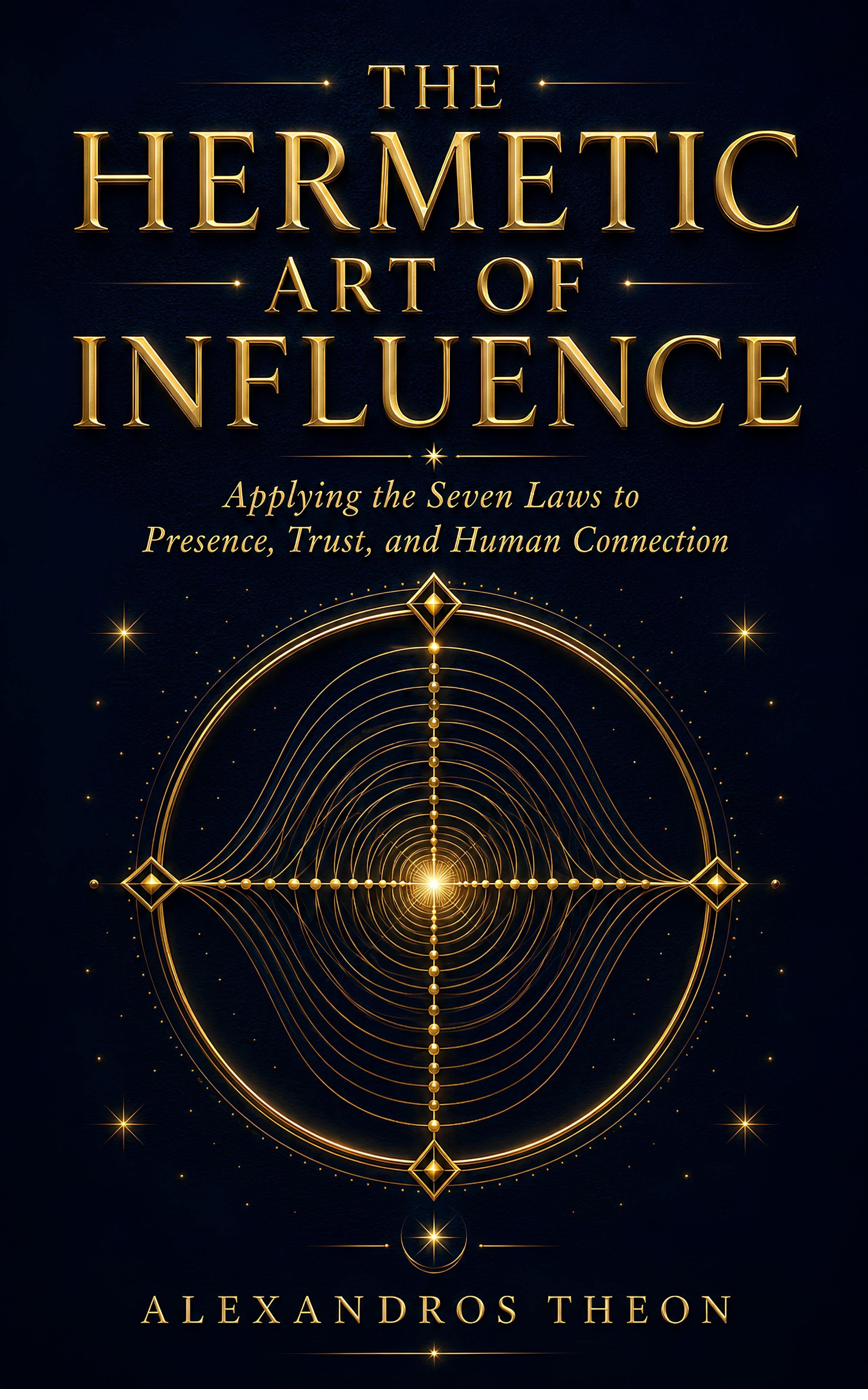
The Hermetic Art of Influence

Alexandros Theon · Presence and trust

Influence is not something you do to people. It is something that radiates from what you have become.

Applying the Seven Laws to Presence, Trust, and Human Connection

Not a manual of persuasion tricks. The market is full of those, and they share one defect no clever tactic can repair: they treat other people as locks to be picked. People sense when they are being handled. This book takes the older, sturdier road. Change the quality of your attention, your timing and your sense of cause, and your effect on others changes without pretense.

ENKindle$4.90ASIN B0FL1966DL

The problem

The techniques work briefly, then corrode the relationships they were meant to improve.

Elena directs a small clinic. She is competent, prepared, and chronically frustrated: her staff agrees with her in meetings and then quietly does otherwise. She bought the books on persuasion. She learned to frame requests, to anchor, to mirror posture. The compliance she gained was thin and temporary, and she could not understand why.

The answer was not in her techniques. It was in her state. Elena arrived at every meeting already braced for resistance. Her sentences were polite; her body was a closed fist. No tactic can solve this, because the tactic is delivered by the very instrument that is causing the problem. You are the medium of every message you send, and an unexamined messenger distorts even the finest message.

  • People agree with you in the room, then do what they had already decided once it empties.
  • You have read the persuasion books, and the compliance they bought you felt thin and did not last.
  • You sense that others read your tension long before they parse your words, and you are right.
  • You want to be trusted, but cannot say what, exactly, makes a person trustworthy in a room.
  • You suspect the problem is not your arguments but the messenger delivering them.

"Influence built on technique borrows authority. Influence built on self-knowledge owns it."

From the first chapter

What this book teaches

Seven lenses for the interior, because the interior is where every room is built.

The seven Hermetic laws are not presented as physics and not as magic. They are lenses, and the book tells their history with rare honesty, including that the tidy list of seven was distilled in 1908 in The Kybalion, not handed down from antiquity. That admission changes nothing about their usefulness and everything about how you hold them. A tool does not need a mythical pedigree to cut well. The work is interior first and relational second.

Govern your own state

Mentalism, Correspondence and Vibration as the load-bearing wall: observe your own interpretations, recognize your repeating patterns, and sense your own emotional weather before others do, since the state arrives in a room before the words.

Read the room and the timing

Polarity, Rhythm and Cause and Effect applied to depolarizing a hardened disagreement, knowing when waiting is the most persuasive act available, and building trust in the small daily denominations that author your reputation.

Keep the ethical line

A full chapter on the code that divides influence from manipulation: the daylight, reversal and residue tests, the stricter duty wherever power is unequal, and the rule every manipulator forgets, that urgency is never an exemption.

Inside the book

What you will find in these pages.

  1. The tradition told honestly, legend and history both labeledWhere Hermes Trismegistus ends and the Corpus Hermeticum begins, how the texts electrified the Renaissance, and the plain admission that the seven laws were organized in 1908. A reader told the truth once tends to trust everything that follows.
  2. Seven chapters, one law each, always the same arcA situation you will recognize, the principle that illuminates it, the way it reshapes how you listen, speak, decide and wait, and a concrete practice you can complete that week. Mentalism through Gender, stripped of fog.
  3. Elena, Martin, Claire and Priya, composites openly declaredAssembled from many real lives so that no real life is exposed: the director who was the meeting she kept attending, the couple who rediscovered their shared axis, the woman who outlasted her winter. What they learned is not composite.
  4. Named practices that build into a presenceThe baseline inventory, the threshold pause, the axis map, the tide log, the causal audit, the opposite hand. Seven weeks of small instruments that do not produce a persuader; they produce a person with a governed interior.
  5. The ethical code, and a seven-week practicumThe whole boundary drawn in ink, with the three ten-second tests, plus a week-by-week practicum and two appendices: the seven laws at a glance and the practices gathered for life after the book.

Who this book is for

This book was written for you if...

  • You want to be genuinely trusted, not merely effective for a week before people sense the handling.
  • You are willing to do interior work, observing your own moods and motives before reading anyone else's.
  • You lead, negotiate, parent or teach, and want presence that does not depend on leverage.
  • You value intellectual honesty: legend and history labeled, analogies declared, an ethics chapter that binds the author too.
  • You can accept a slow, gradual ordering of the interior over an instant toolkit of tricks.

Who should not read it

And it may not be for you if...

  • You are hunting only for leverage over others and intend to skip the interior work. These chapters are disappointing by design.
  • You want scripts, mirroring tactics and calculated pauses. The book argues those corrode the very relationships they target.
  • You need to repair a marriage, treat depression, or resolve a legal matter on your own. This refines presence; it does not substitute for therapy, medicine or law.
Alexandros Theon

About the author

Alexandros Theon

Alexandros Theon is a literary pseudonym. The choice moves the center of gravity away from a personality and toward the library: a line of books created to study, organize and apply ancient principles with contemporary responsibility. The path is that of practical philosophy, with respect for every sincere form of seeking.

In the works of Alexandros Theon there are no promises of cure, guaranteed wealth or instant transformation. When they converse with science, they treat bridges as analogies, not as proof. The commitment is method, clarity and honest practice.

Available on Amazon

"Become someone whose attention is clean, whose word compounds, and whose presence makes other people larger."

Nine chapters, seven named practices, an ethical code and a seven-week practicum. Read instantly on Kindle, your phone or your computer.

Buy on Amazon · $4.90

Courtesy

Read Chapter 1 now, here on the site.

The tradition told honestly, the seven laws in plain language, and why self-knowledge is not the soft preamble to influence but its load-bearing wall. Plus the baseline inventory you can begin tonight.

Prefer to keep it? Download the PDF.

Reader List

Receive future releases.

No spam, no empty promises. Only new books, courtesy chapters and notes from behind the library.