Perceive
Recognize the state you actually carry into a conversation, rather than the one you intend to carry. Most communication failures begin here, in the gap between the two, with a residue you never examined.
 Alexandros Theon
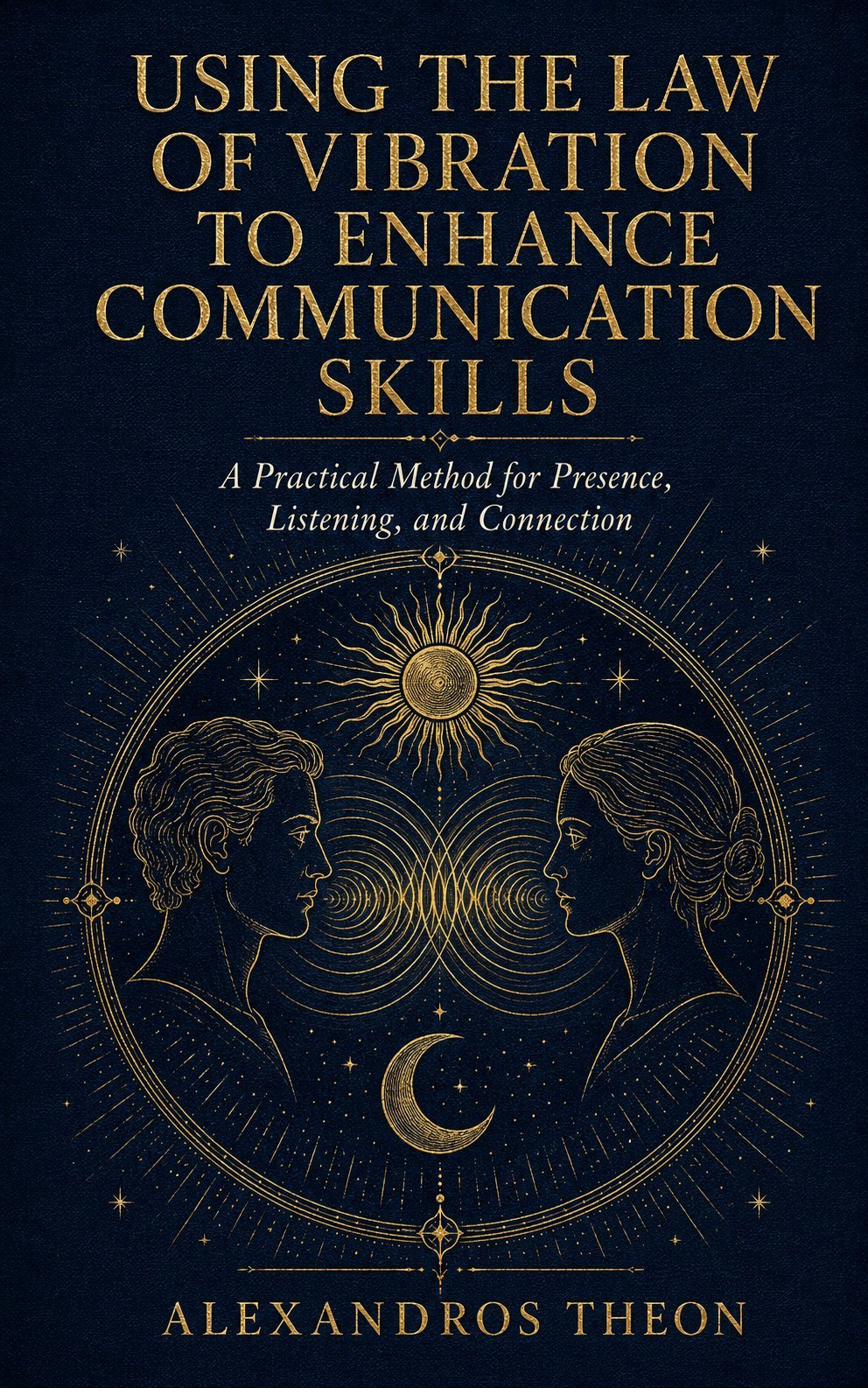
Alexandros Theon · Presence and connection
A Practical Method for Presence, Listening, and Connection
Words travel on a current. When the current is right, modest words do remarkable work; when it is wrong, brilliant words sink. This book is about that current, and about a three-movement method for tending it: perceive the state you carry, attune it before you speak, and resonate with the person in front of you.
The problem
Maya manages projects for a mid-sized firm. One afternoon she walks into a timeline review straight out of four back-to-back calls, the third of them tense. Her slides are reasonable. Her opening sentence is, by any transcript, perfectly fair. And the meeting goes wrong anyway. Her shoulders carry the residue of the two o'clock call. Her first questions arrive a half-beat too fast, with a clipped edge she cannot hear in her own voice. The team can. Within minutes, people are defending rather than thinking.
No one in that room responded to Maya's content. They responded to her state, which she never chose and never noticed. This is the ordinary tragedy the Law of Vibration names: we prepare our words and abandon our state to chance, then wonder why the words misfire.
"State precedes speech. By the time you say your first word, your posture, face, pace, and tone have already spoken."
From the first chapterWhat this book teaches
The Law of Vibration belongs to philosophy and symbol, not to laboratory science, and the book says so on its first pages. It will not tell you that your thoughts broadcast measurable frequencies into the universe. What it claims is more sober and more useful, resting on three facts that are simply true: your voice is vibration in the literal sense and listeners read your inner state from it; emotional states pass between people with remarkable speed; and every conversation has a rhythm that can match or clash regardless of content.
Recognize the state you actually carry into a conversation, rather than the one you intend to carry. Most communication failures begin here, in the gap between the two, with a residue you never examined.
Adjust that state deliberately before and during important exchanges, using practices that work with the body and attention. Not performed calm, which reads as performance, but genuine tuning, slower and humbler, which can be learned.
Read the state of the other person and meet it, so that two rhythms become one conversation instead of two monologues taking turns. The question that gathers, the silence that gives room, the repair made soon.
Inside the book
Who this book is for
Who should not read it

About the author
Alexandros Theon is a literary pseudonym. The choice moves the center of gravity away from a personality and toward the library: a line of books created to study, organize and apply ancient principles with contemporary responsibility. The path is that of practical philosophy, with respect for every sincere form of seeking.
In the works of Alexandros Theon there are no promises of cure, guaranteed wealth or instant transformation. When they converse with science, they treat bridges as analogies, not as proof. The commitment is method, clarity and honest practice.
Continue the journey
The seven laws turned toward presence, trust and human connection, the companion volume to this one.
Merging Hermetic wisdom with modern science, with the same honest boundary between fact and metaphor.
The seven laws as a daily discipline of attention, with named practices and a twenty-one-day plan.
Available on Amazon
Nine chapters, a three-movement method, four territories and a twenty-one-day program. Read instantly on Kindle, your phone or your computer.
Buy on Amazon · $4.90Courtesy
What the Law of Vibration really says: an honest history, the symbolic reading, the three corrections that keep it from becoming pseudoscience, and Maya at three in the afternoon discovering what her team responded to.
Prefer to keep it? Download the PDF.
Reader List
No spam, no empty promises. Only new books, courtesy chapters and notes from behind the library.